
Last month, a consultant engineer hired by the National Association of Broadcasters filed comments with the FCC in opposition to the proposed merger of the Sirius and XM satellite radio networks. These comments stressed the unique transmission and reception infrastructure of each satellite system and pronounced them inherently incompatible. The consultant, Dennis Wallace, asserts (among other things) that the variation in the orbital paths of XM and Sirius satellites, combined with a host of differences involving how the networks encode and compress their digital signals for broadcast, makes each company’s distribution infrastructure nearly impossible to consolidate without “significant disruption” to satellite radio service more generally.
This assertion is belied by two fundamental facts. The first is that XM and Sirius do not serve their subscribers primarily via satellite; instead they use a network of ground-based repeater-transmitters. In most cases, XM/Sirius listeners are not listening to signals directly from space, but instead to a signal bounced from the ground to space and back down again, then rebroadcast from gear bolted to some rented space on a cell phone tower nearby. It doesn’t matter what the difference in XM and Sirius satellites’ orbital paths are – so long as one satellite can “see” the United States (and XM’s constellation is in geostationary orbit), the repeaters will be served, and hence the listeners. Continue reading “Good Cop/Bad Cop: The NAB and Satellite Radio”
Author: diymedia_tu6dox
HD Datacasting Begins In Earnest
Clear Channel recently announced it’s started broadcasting traffic data information on 48 HD Radio-equipped stations around the country. It’s the first use of a digital radio signal for the delivery of content wholly separate from main program audio; the “Total Traffic Network” is a wholly-owned subsidiary of Clear Channel. It’s unclear how this service will compete with Clear Channel’s datacasting partnership with Microsoft, which also seeks to provide traffic information. Continue reading “HD Datacasting Begins In Earnest”
Collage Expansion Underway
I just processed a backlog of new collage-files, featuring both consumer collage and Truthful Translations. The media collage section of the site more generally is undergoing an expansion and overhaul right now, as I prepare to use it for teaching purposes in the fall. If anyone has good suggestions of online, accessible, enjoyable tutelage to be found explaining the intersection of appropriation and art, the potentials of fair use, etc. please drop a line. Continue reading “Collage Expansion Underway”
New LPFM Expansion Effort Launched in Congress
A coordinated introduction of bills in the House and Senate by bipartisan duos suggests the chance to rescind the Radio Broadcasting Preservation Act may be pretty good this year – but, as the Mediageek has already noted, prior Congressional history on this issue means there’s still a lot that must happen before any LPFM expansion becomes law.
There are several factors working both for and against the growth of LPFM. One is that telecommunications and media-regulation issues more generally are occupying a lot more of Congress’ time this session: several large debates related to broadband deployment and network operation, spectrum repurposement, possible corporate mergers (such as the proposed XM/Sirius marriage), and copyright/royalty regulation are already sucking a lot of political time and energy. Continue reading “New LPFM Expansion Effort Launched in Congress”
The Wheels on BusRadio Go Round, Fall Off?
A recent Counterpunch article on BusRadio, the secretive yet insidious company which desires to hard-wire school buses into a closed-circuit radio network chock full of targeted advertising, highlights the company’s struggling fortunes: recently the school board in Jefferson County, Kentucky rejected an overture from BusRadio after mass protest from parents, students, and citizens. Continue reading “The Wheels on BusRadio Go Round, Fall Off?”
Free Radio Olympia Off-Air But Online, For Now
It seems that the FCC’s sweep of microradio is not leaving the old guard alone. Several long-running microradio stations have been visited by the FCC recently, including two individuals specifically targeted from the Free Radio Olympia collective, which sent out this missive: Continue reading “Free Radio Olympia Off-Air But Online, For Now”
FCC Releases Detailed Digital Audio Broadcast Rules
Although the Commissioners themselves voted two months ago to approve the mostly-unrestricted nationwide rollout of HD Radio, the actual regulatory text was just released yesterday. The 74-page document includes basic operating parameters, a second Notice of Proposed Rulemaking on DAB, and Commissioners’ statements (recycled from their March meeting).
A very basic synopsis of the of the rules can be found at the Broadcast Law Blog. On first-read, it’s hard not to notice that the FCC overwhelmingly references just three major stakeholders in the DAB debate: the National Association of Broadcasters, iBiquity, and National Public Radio. The agency consistently defers to industry technical data to justify its decisions, mainly involving studies conducted by iBiquity and “analyzed” by the NAB.
Otherwise, I noted several interesting passages, taken roughly in the order in which the FCC wrote them. Continue reading “FCC Releases Detailed Digital Audio Broadcast Rules”
Pirate Radio USA Available Online
Notes Mediageek, via the documentary’s distributor, B-Side Films. B-Side’s website is currently undergoing a major overhaul/redesign which may impact access, which will not be free. Back when Pirate Radio USA was in post-production Paul did an excellent extended interview with its producers that gives the film some extra context. Continue reading “Pirate Radio USA Available Online”
FCC Enforcement On Record Pace, Again
A long-overdue update to the Enforcement Action Database reveals that the FCC’s conducted more than 130 enforcement actions against pirate stations this year – nearly apace for all of 2005, when the FCC first began taking an administratively tougher stance on unlicensed broadcasting in a post-LPFM world. If this rate of activity stays constant the year could very well end on the north side of 400 enforcement actions.
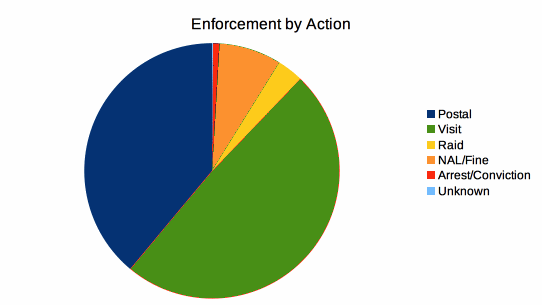 I call the FCC’s posture on pirate radio “administratively tougher” because, as the raw data shows, the agency has a hard time escalating its enforcement protocol. The duration between initial site-visit and follow-up warning letter is now in the 10-day range. Sometimes the period between a warning letter and fine can be as short as a month. Continue reading “FCC Enforcement On Record Pace, Again”
XM Repeater Network Entirely Pirate
Last October it was first disclosed that many of the terrestrial repeater stations used to boost the coverage footprint of the XM satellite radio network were operating without FCC approval. Recently XM filed a document with the Securities and Exchange Commission which seems to suggest the pirate nature of the network is more egregious than first confessed. Up to one-third of the company’s 800 repeater-stations are either placed in locations not approved by the FCC, operating at power levels well above those approved by the FCC, and several are on the air without FCC approval for their placement at all. The scope of such flaunting of the rules is unheard of: some of these illicit repeaters are operating with more than 40 kilowatts of power.
What’s more, it’s clear that XM had an economic incentive to break the law: the majority of its illicit repeaters serve the largest markets. More than half of those placed in the Los Angeles market, for example, are operating “at variance” from what they were authorized for. As a whole, according to XM’s own estimation, the 200+ rogue repeaters serve approximately 42 percent of its network’s total coverage footprint. Continue reading “XM Repeater Network Entirely Pirate”